
By Emmanuel Onyedika
The Nigerian Senate has approved a constitutional amendment bill to establish State Police nationwide, a reform widely described as the most significant change to the country’s security architecture since the adoption of the 1999 Constitution.
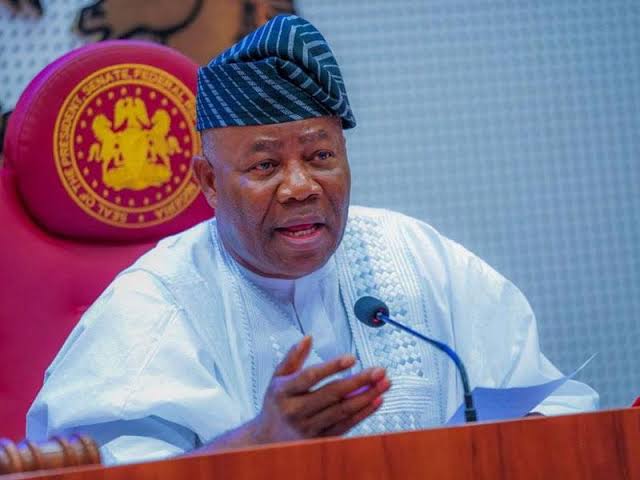
The legislation, titled “A Bill for an Act to Alter the Constitution of the Federal Republic of Nigeria 1999 to Provide for the Establishment of State Police; and for Related Matters (Sixth Alteration)”, was passed during Wednesday’s plenary under the leadership of Senate President Godswill Akpabio.
The Executive Bill was transmitted to the National Assembly by President Bola Tinubu only a day earlier, with a request for accelerated consideration. In an unusual move, the Senate granted first, second, and third readings in a single sitting, reflecting the urgency attached to the measure.
When the electronic voting system failed, senators resorted to a manual count. Lawmakers stood and raised their hands, and a majority of the 109-member chamber voted in favour of the amendment, underscoring broad consensus on the need for reform.
Presenting the bill’s general principles, Senate Leader Opeyemi Bamidele (Ekiti Central) described the measure as one of the most consequential constitutional reforms in Nigeria’s democratic history. He argued that the centralized policing model created by the 1999 Constitution is no longer adequate for Nigeria’s size, diversity, and complex security challenges. Bamidele listed terrorism, banditry, kidnapping, communal conflicts, farmer-herder clashes, cybercrime, organized crime networks, and transnational threats as pressures that have overwhelmed the current structure. He stressed that local authorities lack the capacity to respond swiftly under a centralized system, creating a national consensus on decentralizing policing.
The amendment creates a dual policing framework. A Federal Police Service will retain jurisdiction over federal institutions, the FCT, counter-terrorism, organized crime, cybercrime, border security, and inter-state crimes. States that choose to establish their own police forces will operate State Police Services, empowered to enforce state laws, maintain public order, and protect lives and property locally. To ensure accountability, each state police service must be established by state law and certified as meeting minimum standards prescribed by an Act of the National Assembly before operations can begin. Independent State Police Service Commissions will oversee recruitment, training, promotions, discipline, and complaints.
The bill also includes safeguards against abuse, prohibiting governors from directing state police to target individuals, parties, or groups unlawfully. It bans the use of police powers for partisan, ethnic, religious, or personal purposes. Federal intervention will be allowed only in exceptional cases, subject to presidential authorization, Senate oversight, and judicial review.
During debate, Senator Enyinnaya Abaribe (Abia South) stressed the importance of embedding strong funding and oversight guarantees to keep state police professional and independent. Senator Aminu Tambuwal (Sokoto South) welcomed the bill as a step toward true federalism but cautioned against potential rights violations. Senator Tahir Monguno (Borno North) pointed to existing community security structures as evidence of the need for formal state policing.
The bill now moves to the House of Representatives for concurrence. If passed, it will be transmitted to state assemblies for ratification, as required for constitutional amendments.