

By Tekena Amieyeofori
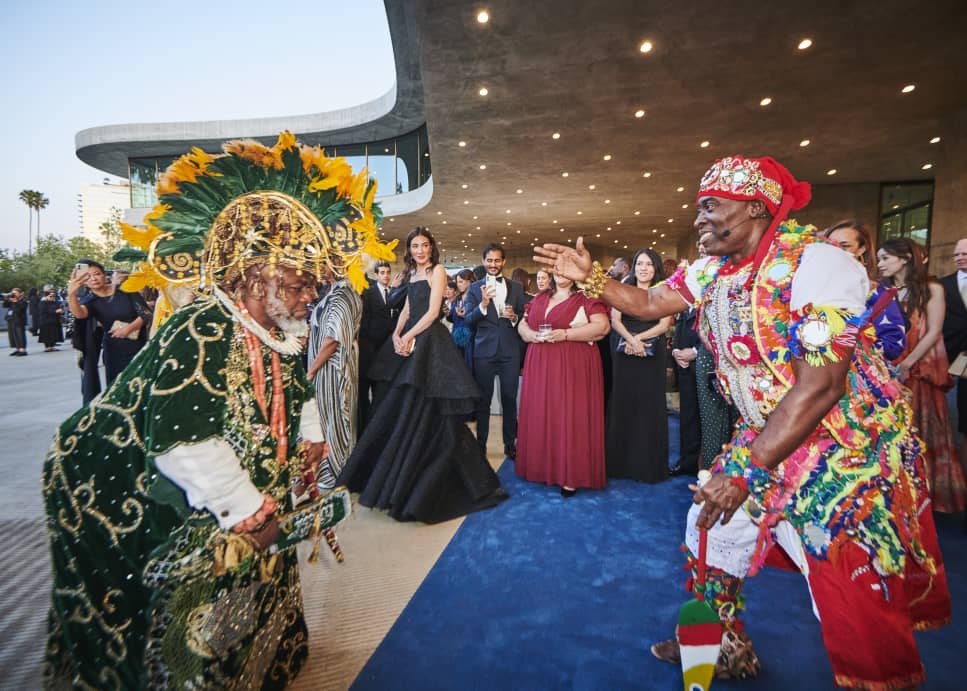
Niger Delta’s foremost cultural ambassador, Yibo Koko, and his Seki Dance drama troupe just returned from the United States. They performed at the prestigious Los Angeles County Museum of Art.
Koko describes the Los Angeles performance as no mean feat: “For Seki to inhabit this space, breathing, dancing, and resonating its open-air expanse is a remarkable milestone in our journey.”
The Los Angeles County Museum of Art is one of the largest art institutions in the western United States, and custodian of the David Geffen Galleries with a collection spanning over 120,000 works across time and space.
A few weeks ago, Koko and his cohorts regaled their audience with a glamorous interpretation of the Niger Delta cosmology. They depicted its people’s valour, industry, and resilience in the midst of structural injustice.
According to Chinua Achebe, “The world is like a mask dancing. If you want to see it well, you do not stand in one place”.
Koko is not just a dancer. He is a theatre manager, art entrepreneur, comedian, and public administrator. But dance is, obviously, his forte.
Whenever he bends to perform his craft, Yibo Koko’s butt vibrates like the elongated lower lobe of the swordfish navigating its way through North America’s waters.
For him, dance is a craft acquired, presumably, from socialising while growing up in the Niger Delta. It is also believed that he encountered destiny at the Crab, the famous enclave designed for practical classes at the Theatre Arts Department of the University of Port Harcourt by the legendary Ola Rotimi.
Both experiences shaped the career path of the “Original Waterside Man.” He became exposed to the rich dance culture of riverine communities early in life. He also had the fortune of grazing from the learning pastures of Uniport, whose Theatre Arts Department has produced an array of stars strutting their stuff in Nollywood.
Unlike many of his colleagues who chose to appear on the screens, Koko opted for stagecraft and dance drama. It was a deliberate choice made to reconstruct the Niger Delta narrative to reflect its true identity through oral tradition.
“Why is it imperative to reconstruct the narrative in the Niger Delta?” you may ask.
The straightforward answer is that the fortunes of the region and its people have declined. They have become a shadow of themselves, victims of misrepresented narratives.
Today, any mention of the Niger Delta reminds the world of a region grovelling under the pangs of oil conflict. Environmental pollution, poverty, political instability, and numbing insecurity also define it.
Consequently, Koko and his colleagues are using their craft to remind the international community of a different truth. The Niger Delta, now painted in negative light, is the same region whose allure they found irresistible in precolonial times.
From time immemorial, the Niger Delta has been a major destination of biodiversity. This is attributable to its sprawling rivers and mangroves hosting some of the world’s rarest species.
The majestic Nun, Forcados, Santa Barbara, and Sombreiro, an ever-flowing artery of beauty, are likened to what Winston Churchill would call “the golden thread” of the region’s history and geography.
Today, the rivers remain heavily polluted after decades of oil spills. Their capacity to support life has been badly eroded, pushing many rare species into extinction.
Nevertheless, Niger Delta is still a sight to behold for the Marco Polos of the 21st century.
The beauty of the Niger Delta is not limited to ecotourism. It is also about the rich cultural tourism that flourished in the region before the advent of British colonialism.
At the time, many visiting Europeans marvelled at the innovation they encountered. Crafts dating back to many centuries, such as bronze-casting and textile production, are still common among the Bini and Akwete people till date.
Like other African societies, the flourishing guilds and crafts in the Niger Delta were deeply embedded in religion. This knowledge shaped the formation of Seki Dance right from its umbilical stage in 1987.
According to Koko, “Seki was born by that encounter, a pantomimic offering shaped by spirit, ceremony, and the eternal dialogue between humanity and the divine.”
Koko further declares that “every gesture is an utterance; the dancers do not merely move, they translate the language of the waters, of ancestors, of time itself.”
However, the art entrepreneur is deeply worried about the present awry state of affairs in Nigeria’s oil hub. “Political racketeering, now commonplace in our communities, is demarketing the region. Even the media that ought to set agenda for importation of foreign direct investments are carried away with sensationalism,” Koko laments.
Seki, known and referred to as Owuamapu Ti at inception in 1987, has evolved over the years. On May 27, 1998, it found its voice on the stage of the Shell Hall at the MUSON Centre in Lagos.
In the years that followed, Seki received recognition on CNN’s “African Voices,” opening doors for it to amplify the real voice of the Niger Delta before global audiences.
In recent years, Seki has been received on distinguished stages in Manhattan and St. Ann during Jamaica’s Independence Anniversary. It has also been honoured by the invitation of His Excellency Felix-Antoine Tshisekedi Tshilombo to perform at Africa Music Week, including a command performance at the Presidential Gala Dinner marking the nation’s adoption of a rotating presidency for the SADC.
This April, the troupe staged its most recent global performance in Los Angeles. The invitation from an art institution with such a reputable global standing demonstrates institutional recognition and artistic merit.
That performance was not just an appearance. It was a profound affirmation from the Los Angeles County Museum of Art.
Having bestrode the global arena with colossal grit, Seki Dance now returns home. This December, it sets out to make Port Harcourt city bubble and shuffle once again.
It promises to be a December to remember for families and friends, through expressive storytelling, rhythmic dance steps, and artful rendition of the people’s cultural heritage.
Yet no homecoming should pass unnoticed. The arts community in the Niger Delta is calling for meaningful buy-in from state governments and corporate bodies, so the prophet will not be without honour in his own land.
Seki is more than a performance; it is cultural diplomacy in motion, a living archive of Niger Delta identity, dignity, and hope.
For stakeholders who truly believe in the region’s future, this December offers a rare chance to invest in a product built to promote cultural nationalism and reposition the Niger Delta before the world.