
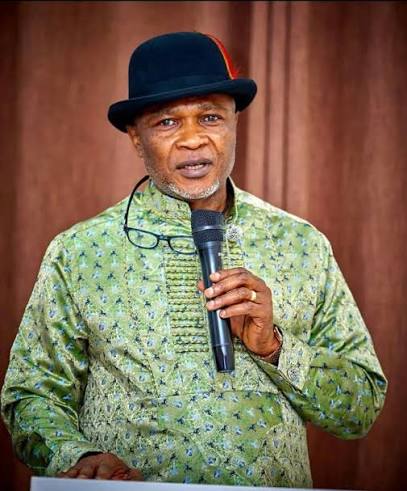
By Tekena Amieyeofori
In the run-up to the 2027 governorship election in Rivers State, most observers, including critics of the All Progressives Congress, APC, candidate, Rt. Honourable Ogundu Kingsley Chinda, admit that he is the right candidate for the top job. Despite Honourable Chinda’s wide popularity, his ethnic identity is now being weaponised by a tiny section of the populace – proponents of political zoning – to sway public opinion against him.
The target is a man with a pan-Rivers agenda, one who has come fully prepared to make governance more relevant to the needs of the people, regardless of their ethnic and cultural backgrounds.
Zoning in Nigerian politics is the practice of rotating political offices among disparate ethnic groups and regions. Although it is often touted as a means of promoting political inclusion and a shared sense of belonging, practical evidence shows that zoning does more harm than good in ethnically diverse societies like Rivers State.
Restricting the candidate pool to a particular region in the name of zoning effectively shuts the door against qualified and more competent individuals. Painfully, it sidelines visionary leaders and, in their place, elevates mediocrity on account of ethnic or regional identity.
Beyond politics, zoning weakens institutions when leadership becomes a matter of place of origin rather than capacity. When merit is sacrificed for ethnic and regional considerations, governance suffers, and citizens are denied the best minds to solve national and sub-national problems. Needless to say, democracies thrive and nations prosper not when power rotates by the dictates of geography, but when it gravitates towards capable hands.
Historically, zoning was an invention of political leaders in the Second Republic to address the fierce regional competition for power that arose in the First Republic. Over the years, it has bred a sense of entitlement among political actors and promoted an unwholesome political mindset of “it is our turn to eat.” It is the same mentality that fuels corruption and the inequitable distribution of physical and social infrastructure when ill-equipped beneficiaries of zoning ascend to power.
The unintended consequence of zoning is governance exclusion that results from this focus on entitlement. Communities outside favoured regions are often not considered a priority in governance. This gives rise to feelings of marginalisation, conflict, and underdevelopment.
In the Fourth Republic, zoning has become a major driver of identity politics, undermining the national ideal of unity in diversity. What began as a mechanism for inclusion has mutated into a Frankenstein monster, tearing at the fabric of national unity to serve the interests of a few political elites at the expense of the generality of the people. Sadly, this troubling trend continues to worry patriotic Nigerians.
As veteran journalist Eric Teniola once asked: “How come a policy designed to unite the country has ended up dividing us?”
It is in this climate where geography is placed above capacity and sentiment above service that the candidacy of Rt. Hon. O.K. Chinda presents Rivers State with a defining choice. The choice is between the politics of entitlement and the politics of competence. Between a system that asks “where are you from?” and a leader who asks “what do you need?”
With Honourable Chinda as a front-runner in the governorship race, indications are rife that the people will disregard the political propaganda intended to sow seeds of discord under the guise of supporting zoning in Rivers State. This is because the man has built a solid reputation for himself, armed with an unrivalled track record that is resonating strongly in the race for the Brick House.
Honourable Chinda currently represents Obio/Akpor Federal Constituency in the House of Representatives. His epic leadership journey began at Rivers State University where he went to study Law. Those campus years were the first glimpse of a leader in the making, as his foray into student unionism sharpened his voice and taught him the art of advocacy, grassroots mobilisation, and public engagement.
As a law student, Rt. Honourable Chinda was drawn to issues of justice, leadership, and community development. His legal training did more than qualify him for active practice, it gave him a framework for understanding how institutions work, how rights are protected, and how public service is discharged. It taught him that the law does not recognise zones, it recognises citizens. That principle has guided him ever since.
Honourable Chinda began his public service as Legal Adviser to the Obio/Akpor Local Government Council. In that role, he provided legal guidance and administrative support, learning first-hand how policies touch the everyday lives of people at the grassroots.
He later served as Rivers State Commissioner for Environment. In that capacity, he oversaw policy formulation, environmental management, and state-wide initiatives aimed at protecting natural resources and public health. The office did not serve one senatorial district, it served the entire state. At the time, the floods in Ahoada mattered as much as the erosion in Etche. That experience reinforced his belief that governance must be blind to origin and alive to need.
Since 2011, Honourable Chinda has been representing Obio/Akpor Federal Constituency in the House of Representatives. He has been a strong voice on the floor of the National Assembly with a legacy of impactful lawmaking. With his track record of accountability, fearless advocacy, and legislative excellence, the governorship hopeful has been entrusted with key leadership positions in the Green Chamber over the past 15 years. Some of the positions he has held include Deputy Chairman, House Committee on Customs and Excise, and Chairman, House Committee on Public Accounts. Shortly after the 10th National Assembly was inaugurated in 2023, Honourable Chinda became Minority Leader of the House, a position that placed him at the centre of legislative strategy and national debate.
As member representing Obio/Akpor Federal Constituency in the House of Representatives, Honourable Chinda has sponsored and co-sponsored over 20 bills, including prominent ones like the Electoral Offences Tribunal and Commission Establishment Bill and the Agency for Artisanal Petroleum Refining Bill. He also has a record of more than 30 motions seeking critical resolutions on economic welfare, minimum wage, and public accountability. To date, the quintessential lawmaker has equally handled 10 legislative petitions arising from his constituents’ complaints. None of these interventions were limited by zone. They were driven by the urgency of the issues and the welfare of Rivers people and the rest of Nigerians.
In demonstrating political fidelity to his constituency, he has successfully conceived and executed over a hundred projects and programmes that are verifiable in the public domain.
Crucially, these projects were not sited by zone, quota, or political patronage. They went to communities with the greatest need, the way governance should work when merit, not origin, is the benchmark. Road construction at Alhaji Estate, Rumuodomaya, drainage at Eliowhani, and the installation of transformers to boost rural electrification across various communities were all need-based interventions. Others include the donation of medical equipment to promote quality and affordable healthcare, and the construction of classroom blocks at Rukpoku, Rumukwurushi, and Choba, just to mention a few. This is the template he intends to bring to the Brick House: needs-based governance, not zone-based sharing.
Honourable Chinda’s towering achievements at the nation’s apex lawmaking institution come as no surprise. His political path has moved steadily upward — from local government to state executive duties, and eventually to the National Assembly. Each stage added weight, experience, and wider perspectives to his governance approach. At each level, he has demonstrated that effective leadership is not about representing a subsection, but about solving problems for all.
A top contender for the governorship of Rivers State, Honourable Chinda has developed a comprehensive blueprint focusing on six pillars: Technology, Agriculture, Health, Education, Transportation, and Infrastructure. All six pillars combined are intended to reposition Rivers State as a national economic productive hub and a leading investment destination. They provide the roadmap to job creation, wealth generation, poverty reduction, and sustainable peace and development in the nation’s “Treasure Base.”
This blueprint is deliberately pan-Rivers. Technology hubs will not be zoned to one senatorial district. Agricultural value chains will cut across riverine and upland communities. Health centres of excellence will be sited where disease burden is highest, not where rotation says it is “their turn.”
A Chinda administration will operate a government of inclusion. Key appointments, projects, and policies will reflect the diversity of all 23 Local Government Areas and three senatorial districts. Not by quota, but by competence drawn from every part of Rivers State. Every community will have a seat at the table, and every community will see itself in the government.
The man whom the people are massively rooting for has assured them that “We will govern Rivers State with the fear of God and love for mankind.” As things stand, the people are truly convinced that this is not another empty political promise, judging from the man’s political antecedents as one who keeps to his word. For 15 years in the National Assembly, he has voted on bills, not based on where the sponsor hails from, but on how the bill serves Nigerians. That is the kind of judgment Rivers people need in the Brick House.
The 2027 election is not just about who occupies the Brick House. It is about what kind of Rivers State we want to build for the next generation.
Rt. Hon. O.K. Chinda offers a different path. A path rooted in capacity, in proven service, and in a vision that cuts across all 23 Local Government Areas and communities in Rivers State. He is not running to represent a zone. He is running to serve a state. He is not asking for power because of where he comes from. He is asking for the opportunity to serve because of what he has done, and what he is prepared to do.
To those still clinging to the outmoded shibboleth of zoning, the message is clear: the train of good governance is moving. Rivers people are already on board. The naysayers can stay at the station arguing about rotation, or join the journey that takes us to where we should be as a people.
A vote for O.K. Chinda is a vote for good governance. It is a vote for peace. It is a vote for progressive leadership that puts Rivers people first, ahead of primordial sentiments, and ahead of the politics of exclusion.
The time has come to choose credibility over zoning. The time has come to choose competence over quota. The time has come to choose Rivers State.