
By Priye Briggs
Voters across Osun State trooped out on Saturday, August 15, 2026, to choose who will lead the “State of the Living Spring” for the next four years in an election widely seen as a test of both voter confidence and INEC’s readiness.
The governorship poll is being organised by the Independent National Electoral Commission, INEC, and is holding in all 30 local government areas of the state.
According to INEC, Osun has 2.3 million registered voters. Officials expect turnout to reach about 1.9 million. Fifteen candidates are on the ballot in what has shaped up to be a tight contest between the incumbent and a field of challengers banking on economic hardship, security and youth unemployment as key campaign issues.
Early Start, Massive Turnout
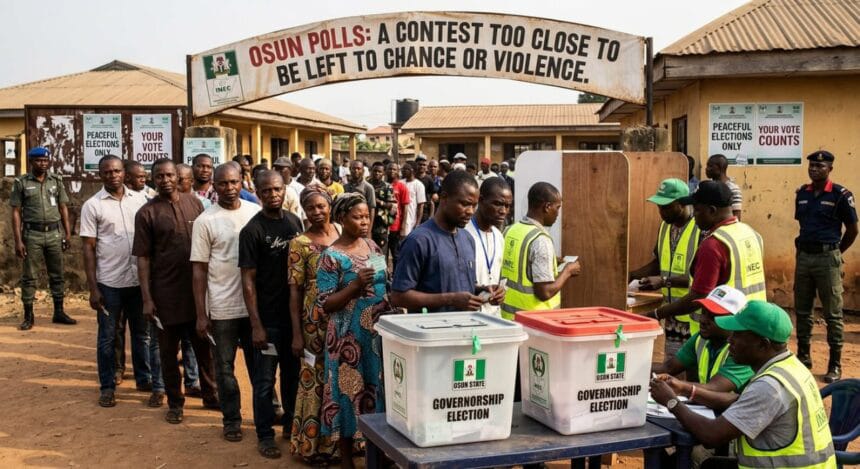
Accreditation and voting began at 8:30 a.m. after election materials were distributed and deployed to polling centres early in the day. In many units, voters had gathered as early as 7:00 a.m., forming orderly queues ahead of INEC officials.
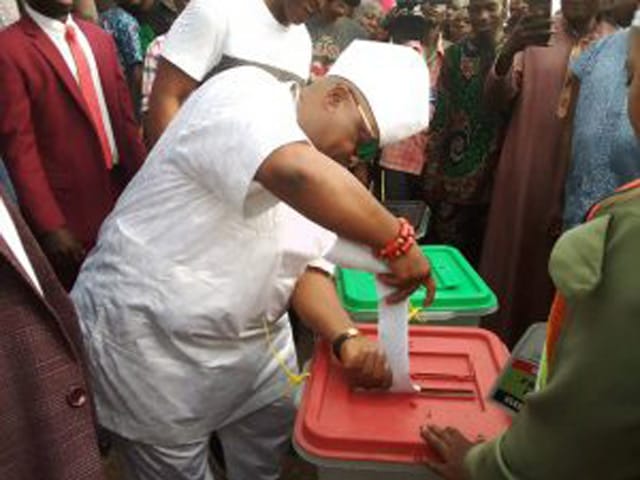
At about 9:10 a.m., Governor Ademola Adeleke cast his vote at Abogunde Comprehensive 009, Ward 02, Abogunde Sagba, Ede North.
The governor, who is running on the platform of the Accord Party, arrived at the unit at 8:36 a.m. for accreditation before voting. His presence drew a large crowd of supporters and party faithful, with security operatives maintaining a tight perimeter around the area.
Adeleke’s candidacy makes the race unusual, as a sitting governor is contesting under a different party banner from the one that first brought him to office. Analysts say the outcome will signal how much of his welfare-focused governance in the last term has resonated with voters.
Moments of Tension
In Ejigbo, tension briefly arose at Iroyin Ayo Open Space Polling Unit 013, Elejigbo D/Elejemo Ward. Party agents demanded that presiding officers count every ballot paper before voting started.
The presiding officers, however, said counting all the ballot papers could delay the commencement of the process.
The standoff was eventually resolved after supervisors intervened, and voting proceeded peacefully.
The unit has 594 registered voters and is also the polling unit of ADC governorship candidate, Najeem Salam. Salam’s participation has given the ADC a visible presence in the race, particularly in Osun West where the party has been working to build grassroots structures.
Observers from civil society groups were on ground to monitor compliance with the Electoral Act, with a focus on timely arrival of materials, proper use of the BVAS, and adherence to voting procedures.
Preparations and Logistics
At Sabo Agbongbe II, Ward 7, Polling Units 001 and 011 in Ede LGA, voting cubicles and other materials were already in place by 7:50 a.m., with INEC officials making final preparations.
Some voters checked for their names on the register pasted at the units while others waited in queues to be accredited. Many said they came early to avoid the midday heat and possible last-minute rush.
There was also a massive turnout at Egbedore Ward, Abogunde Primary School polling unit, where residents gathered for accreditation and voting. Similarly, voters assembled at Unit 7, Oke-Oja in Osogbo as INEC staff set up for the exercise. In Osogbo metropolis, commercial activities were subdued as voters prioritised the poll, while patrol teams of security agencies moved across major roads.
Distribution of sensitive and non-sensitive materials began from 7:00 a.m., with INEC trucks moving supplies to different parts of the state ahead of the opening of polls. The Commission had earlier assured that all 3,763 polling units would receive materials on time, and early reports from 28 of the 30 LGAs indicated compliance.
What’s at Stake
Beyond the personalities on the ballot, the election is being keenly monitored and observed for what it says about governance in Osun. Key issues dominating voter conversations include payment of salaries and pensions, infrastructure in rural areas, school feeding, and the rising cost of living.
With 15 candidates in the race, no party is taking victory for granted. Political watchers note that the margin of victory may come down to voter mobilisation in Ede, Osogbo, Ilesa and Iwo, the state’s four major urban centres.