
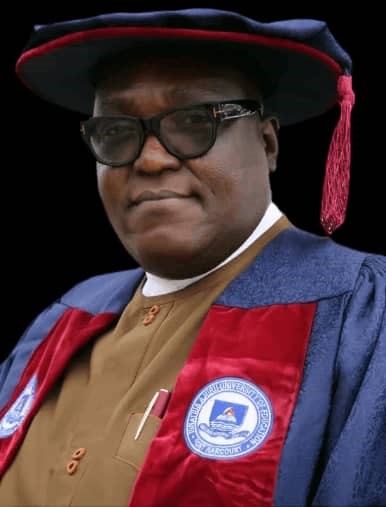
By Tekena Amieyeofori
For two days in May 2026, the auditorium of Ignatius Ajuru University of Education, Rumuolumeni, Rivers State, Nigeria hummed with a different kind of energy. The 44th convocation ceremony brought together graduates, parents, staff, and dignitaries to mark the formal exit of students who had spent years within IAUE’s learning community. Academic gowns, flashes of cameras, and the rhythm of the procession gave the event its colour. But beyond the ceremony, the convocation told a deeper story about the institution itself: what it means to take over a university with urgent problems, and to leave it visibly changed five years later.
When Prof. Okey Onuchuku assumed office as Vice-Chancellor in November 2021, IAUE faced the kind of challenges familiar to many Nigerian universities in transition. Students paid fees upfront with little flexibility, cultism was a growing concern, and the main gate at the Rumuolumeni campus created daily traffic bottlenecks that spilled onto its immediate vicinity of many adjoining internal roads. Academic programmes needed restructuring and accreditation, infrastructure lagged behind student numbers, and staff morale required attention.
Five years later, the picture has changed. The main gate at the Rumuolumeni Campus has been dualised to ease traffic flow. Fees can be paid in two installments, reducing pressure on families. Security has been strengthened across IAUE’s three campuses. Academically, the university has expanded its offerings, securing accreditation for dozens of programmes, while faculties have been repositioned to reflect contemporary disciplinary needs. The transformation has not been accidental. It is the product of deliberate policy choices anchored on academic excellence, administrative innovation, and infrastructural renewal.
Before examining the record in detail, a brief look at IAUE’s history shows why this moment matters.
From Teacher Training College to University
IAUE’s origins lie in Nigeria’s post-civil war push to expand teacher education. Established as an Advanced Teachers’ Training College in 1971, it responded to a critical shortage of qualified teachers in Rivers State’s post-primary schools. In 1975, it was upgraded to Rivers State College of Education, and by March 1978 it graduated its first cohort of 462 students with the Nigeria Certificate of Education.
The next phase came in 1982 when the College began offering Bachelor of Education programmes in affiliation with the University of Ibadan. The most significant structural change arrived in 2009 with the passage of the University of Education Law No. 8 by the Rivers State House of Assembly. On October 20, 2009, former Governor Chibuike Rotimi Amaechi formally announced the institution’s upgrade to a university. In 2010 it was renamed Ignatius Ajuru University of Education, honouring the late Ambassador Ignatius Ajuru, who had championed its elevation while serving as Chairman of the Governing Council.
The institution’s upgrade brought autonomy and prestige, but also the growing pains typical of young universities. Programmes needed alignment with National Universities Commission (NUC) standards. Infrastructure had to catch up with new student loads. Administrative systems required modernisation. Ethical standards and campus security demanded consistent policy. By 2021, IAUE needed a leadership intervention that could address these issues simultaneously without losing focus on its core mandate of teacher education and knowledge production.
The Leadership Brief: Academic Restructuring and Accreditation
It was in response to the aforementioned challenges that immediate past Governor Nyesom Wike appointed Prof. Onuchuku to oversee the institution’s affairs in 2021. Fortunately, Professor Onuchuku’s first step was an academic audit. The goal was clear: expand relevant programmes, restructure faculties for efficiency, and ensure every course meets NUC’s minimum standards.
The restructuring saw all education courses moved into a stand-alone Faculty of Education. This freed other faculties like Humanities, Social Sciences, Management Sciences, and Natural and Applied Sciences to develop and award degrees in their core disciplines without overlap. For the first time, the Faculty of Vocational and Technical Education has been unbundled into the Faculty of Agriculture (with six departments) and Faculty of Vocational and Technical Education (three departments). New programmes introduced include Human Resource Management, Banking and Finance, Public Administration, Software Engineering, Social Work, and others aligned with Nigeria’s economic and technological needs.
At the postgraduate level, IAUE adopted a minimum three-year academic calendar for doctoral programmes, bringing it in line with global norms. A quality assurance unit has been strengthened to monitor teaching, supervision, and examination processes continuously.
The results have been measurable. At the moment, 53 out of 79 academic programmes (both old and new) offered at the undergraduate level have received full accreditation status from the NUC and professional regulatory bodies. Additionally, 26 new academic programmes at the undergraduate level, 28 postgraduate programmes, and part-time programmes for suitably qualified candidates have undergone resource verification by the apex academic regulatory body in Nigeria. The introduction and approval of new academic programmes had increased the institution’s admission quota for regular undergraduate programmes from 6,000 in 2022 to 10,000 by 2025. For students, this means certificates that carry weight. For the university, it means institutional credibility and eligibility for more research grants and partnerships.
ICT Revolution at IAUE
Considering that no meaningful learning can take place in the 21st century without ICT penetration, the university has significantly digitalised its processes over the years. It has automated and upgraded its digital payment platform across all transactions for graduate, postgraduate, College of Continuing Education, and Institute of Long Distance Learning Schools. The IAUE has also integrated its e-learning platform to enhance teaching and learning, strengthening access to research through collaborations with internet service providers. Through this measure, it has achieved an automated result processing system to protect all results approved by the Senate for semester and final graduations.
Welfare: Rebuilding Trust Between Staff and Students
Universities thrive on relationships. When trust erodes between staff and students, academic standards suffer. One of Onuchuku’s early interventions targeted this directly.
To address concerns about grading, transparency, and academic exploitation, IAUE introduced a conference marking policy. Under this system, contested scripts are reviewed by Heads of Department, Deans, and relevant academic staff, reducing the risk of arbitrary grading and building confidence in the examination process.
Staff welfare has received parallel attention. Under Professor Onuchuku’s watch, the university has promoted 150 academic staff to the Professorial level, including 63 full Professors and 87 Readers. Annual welfare packages have been consistent for both academic and non-academic staff. So far, the university has sponsored over 80 internal and external Departmental, Faculty, and Association conferences for teaching and non-teaching staff. Research support funds are also made available, signaling that scholarship is not just expected but resourced.
Infrastructure: Changing the Physical Face of IAUE
A university’s intellectual life is shaped by its physical environment. Under Onuchuku, IAUE has undertaken one of the most visible infrastructure drives in its history.
New buildings have risen across the three campuses. These include the English House, a new Faculty of Social Sciences complex, the Estate Department building, and a modern female hostel. Power and water supply systems have been upgraded with the purchase and installation of power generating sets in the campuses, addressing two of the most persistent challenges for students and staff.
In the last five years, infrastructure upgrade at the IAUE has been rapid and evenly distributed across its three campuses. The main campus now wears a brand-new look with well-paved internal roads and a newly-completed motor park to facilitate bus shuttles. It has also benefitted from the installation of solar/inverter power systems at the students’ hostels and ICT Unit.
At the institution’s satellite campuses, perimeter fencing has also been completed, with the reconstruction of a security post at the St. John’s Campus. These measures now secure all campuses, and internal security operations have been professionalised.
Cultism, which had been a persistent threat, has been on the decline. The university’s strategy combined enforcement with sustained awareness programmes, peer mentoring, and collaboration with security agencies. The goal was not just to suppress violent incidents but to change the campus culture around belonging and identity.
Transparent Use of Intervention Funds
Professor Onuchuku’s administration has attracted intervention funds from the Niger Delta Development Commission (NDDC) and the Tertiary Education Development Fund (TETFUND), ensuring their transparent utilisation to provide key projects at the IAUE. These projects include the NDDC-funded renovation of Departmental Laboratories of Chemistry, Biology, Integrated Science, and Special Education Centre.The scope of NDDC intervention also includes ongoing construction of 1.9km internal road in the New Haven axis of the main campus, buildings of the university’s gatehouse at its main entrance, installation of solar street lights across the three campuses, and completion of Corpers’ Lodge at Ndele Campus.
The TETFUND-sponsored projects include construction and furnishing of buildings housing the Faculties of Social Sciences, Education, Vocational/Technical Education and Agriculture. Others are a project executed to improve the physical and automated (e-library) units of the university library, entrepreneurship funding, career centre support, staff development support, as well as the 2025 Intervention Allocation for the building of Faculty of Agriculture, and Vocational/Technical Education at the Ndele Campus.
Standing conspicuously at the Rumuolumeni Campus is the Okey Onuchuku Building donated by the Vice-Chancellor to house the Okey Onuchuku Institute of Peace and Conflict Studies. Funds for the execution of the project were raised from donations made at a book launch marking Professor Onuchuku’s 60th birthday ceremony on April 4, 2025.
This personal donation made by the Vice-Chancellor himself carries significant weight. The conferment of ownership on the IAUE makes the Institute more visible for research, training, and external partnerships in peacebuilding which is relevant for the Niger Delta context. Already, the Okey Onuchuku Institute of Peace and Conflict Studies has become part of IAUE’s institutional memory that outlives the Vice-Chancellor’s time in office.
Recreation/Sports
The famous English saying that “All work, and no play, makes Jack a dull boy” applies at the IAUE. It has refurbished the Senior Staff Club to cater for the recreational needs of staff and their guests within the university community and has enhanced its competitiveness in national sporting activities.
In addition to its academic milestones, the IAUE has recorded sporting excellence in recent years. In the 2022 Nigerian University Games (NUGA), it notched up to 7th position, carting away five gold, four silver, and one bronze medals. In 2023, four of its athletes participated in the World University Games hosted by China.
This feat could not have been achieved without the mentorship of a Vice-Chancellor who in his undergraduate days at the University of Port Harcourt was a celebrated goalkeeper of the school’s football team. There is no gainsaying that if the IAUE is able to complete and put into use its new sporting facilities initiated and executed under his watch, it would definitely stand out as first among equals in the post-Professor Onuchuku era.
The Man Behind the Model
Leadership of this scope requires both academic depth and administrative experience. Prof. Okey Onuchuku fits that profile.
He earned his B.Sc in Economics from the University of Port Harcourt in 1990 and completed his PhD in 1998. His academic focus lies in Economic Theory, Policy, and Quantitative Economics, with specialisation in econometrics and mathematical economics. He furthered his training at York University, Canada, and the Schulich School of Business Executive Centre, obtaining a certificate in Performance Indicators in Governance with a focus on management and measurement.
Before moving to IAUE, Onuchuku spent years at the University of Port Harcourt, serving as Head of the Department of Economics, Dean of the Faculty of Social Sciences, and pioneer Director of the UNIPORT Business School. He is a lifetime member of the Nigerian Economic Society and has consulted for national and international agencies on economic growth and development.
His scholarly output includes several books and articles in local and international journals. That academic grounding has informed his administrative style at IAUE: data-driven, process-oriented, and focused on measurable outcomes. His record has earned him recognition beyond Rivers State, including Vice-Chancellor of the Year and the African Leader of Integrity Award at the 19th African Leadership Development Conference in Accra, Ghana.
The Broader Significance: From University of Education to Conventional University
One of the defining achievements of the Onuchuku era is the transformation of IAUE’s academic identity. While retaining its strong Faculty of Education, the university has expanded into a conventional university model. New courses in management, technology, social sciences, and agriculture give students options beyond teaching.
This matters for Rivers State and the Niger Delta region. Graduates now enter the oil and gas sector, public administration, finance, and technology spaces with degrees that match market demand. At the same time, those trained in education and the humanities remain equipped for Nigeria’s growing service economy, where innovation and communication skills are increasingly valued.
The shift also positions IAUE to attract partnerships, research funding, and student mobility agreements that were harder to secure under a narrower academic structure.
Challenges Remaining and the Road Ahead
No honest assessment of IAUE’s progress can ignore what remains undone. Incumbent Governor Siminalayi Fubara has approved the recruitment of 1,500 teaching and non-teaching staff to enhance productivity at the institution. However, there is still need to recruit more staff, particularly non-teaching staff, as many are retiring.
Moreover, funding gaps persist, as they do across Nigeria’s public university system. Addressing these gaps will enable IAUE get a befitting Senate Building, Vice-Chancellor’s Lodge, Multipurpose Convocation Arena, more classrooms and offices and many urgent needs.The Pro-Chancellor, Dr. Chinyere Igwe, captured this reality recently when he noted that “it is not yet Uhuru” for the institution.
Yet the direction is clear. The foundation laid between 2021 and 2026 is one of institutional stability, academic credibility, and infrastructural momentum. The next phase will depend on sustaining fiscal discipline, deepening research output, and expanding digital learning infrastructure to keep pace with global education trends.
For graduating students, the immediate benefit is clear: they leave with degrees from an institution whose programmes are accredited, whose environment is safer, and whose reputation is on an upward curve. For Rivers State, IAUE’s renewal means a stronger pipeline of teachers, administrators, entrepreneurs, and professionals.
Conclusion: Leadership as Translation of Vision
Warren Bennis once defined leadership as “the capacity to translate vision into reality.” At IAUE, this definition feels tangible. The university’s journey under Prof. Onuchuku has been anchored on three pillars: academic excellence, administrative innovation, and infrastructure upgrade. Each pillar has produced measurable outcomes like accredited programmes, improved welfare systems, new buildings, and a calmer campus culture.
As Onuchuku prepares to conclude his tenure, his record offers a case study in what focused university leadership can achieve in a short timeframe. The institution he inherited in 2021 and the one he is leaving in 2026 are not the same. That difference is visible in the lecture halls, in the new buildings, in the student files, and in the broader academic environment where graduates now walk out with greater confidence.
The theme for the institution’s 44th Convocation Ceremony was “The Story of Academic and Administrative Progress: The Case of IAUE”. It was indeed a convocation that told more than a graduation story. Undoubtedly, Prof. Onuchuku’s name is already inscribed in IAUE’s recent history, not as a promise, but as a record of work completed.